About this article
Medically reviewed- Written by
- Dr Paul Watson
- Medically reviewed by
- Dr Han Simpson
- Published
- April 13, 2026
- Medical review date
- September 8, 2026
- Evidence searched through
- September 8, 2026
- Next review due
- September 8, 2027
- Intended audience
- General Readers & Patients
- Geographic scope
- Worldwide
- Conflicts of interest
- None declared.
- Funding
- Website Owner
- Report a correction
- Report an error or editorial concern
- Medical disclaimer
- Read the medical disclaimer
Finding clear fluid in your ear when nothing hurts is unsettling. And we have seen a lot of people type into our website “Ear Leaking Clear Fluid No Pain”, so it is a common problem. Individuals often expect pain if something is wrong with the ear. When there isn’t any, it’s easy to dismiss it as bath water, sweat, or a minor irritation.
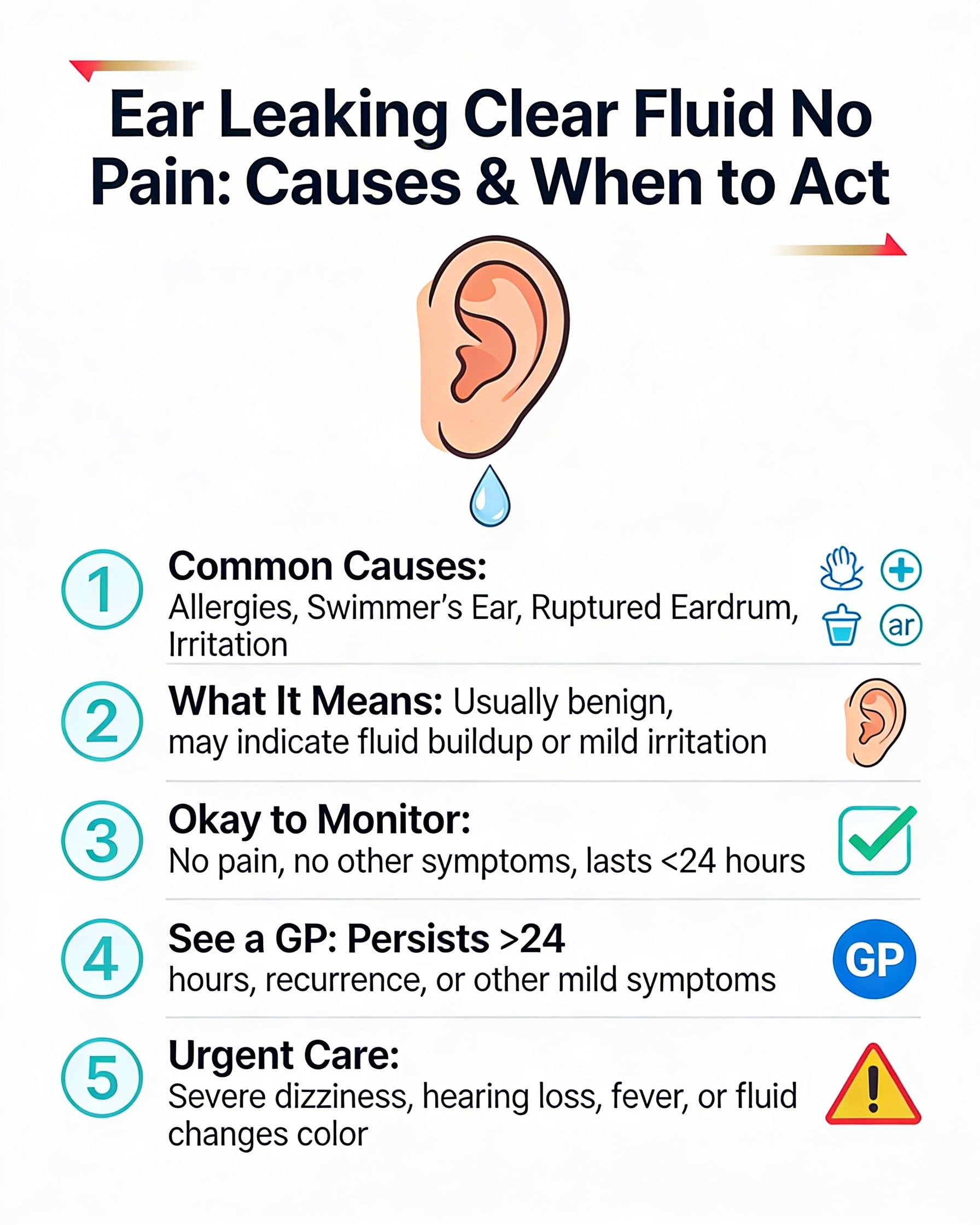
Sometimes it is something simple. Sometimes it isn’t.
As an ENT would tell you in clinic, the key question isn’t only “what is the fluid?” but also “where is it coming from?” A small amount of trapped water behaves very differently from middle ear fluid, and both are very different from the rare but important possibility of a cerebrospinal fluid leak.
If you searched for ear leaking clear fluid no pain, you probably want two things right now. Reassurance, and a clear plan. You’ll find both here. This guide is meant to help you understand what may be happening, what warning signs matter, and what kind of testing a doctor may use. It’s general education, not a diagnosis, and a medical evaluation is still the right next step if the fluid keeps coming back or if anything about it seems unusual.
An Introduction to Painless Clear Ear Drainage
Clear drainage from the ear without pain falls into a frustrating category of symptoms. It can look minor and still deserve attention.
Many people first notice it on a pillowcase, after a shower, or when touching the outer ear and feeling unexpected dampness. If hearing feels normal and there’s no ache, they often wait. That reaction is understandable, but it can delay the right diagnosis.
A useful way to think about this symptom is to sort it into three broad possibilities:
- Something from outside the ear such as trapped water
- Something from the middle ear such as thin, non-infected fluid behind the eardrum
- Something much less common but more serious such as a leak of fluid that should never be exiting the skull
Most cases are not dangerous. But the rare dangerous cause matters enough that painless ear drainage should never be ignored if it’s persistent, recurrent, or follows a head injury.
Practical rule: If clear ear fluid keeps showing up and you can’t confidently explain it with a recent shower or swim, get it checked.
People often get confused because “clear fluid” sounds like one thing. It isn’t. Water, thin middle ear fluid, and cerebrospinal fluid can all look similar at first glance. The context is often the clue. Did it happen after swimming? After a cold? After a fall? Does it drip once, or keep returning?
Another point that causes confusion is pain. Pain can be absent even when the cause is important. A symptom doesn’t have to hurt to matter.
You don’t need to diagnose yourself at home. What helps is paying attention to a few details you can report clearly: which ear, how often, how much, whether hearing feels muffled, whether you recently had a cold or allergy flare, and whether there was any head or neck injury.

Understanding Your Ear’s Anatomy and Fluids
The ear is easier to understand if you picture it like a home with three connected rooms. Each room has a different job, and fluid problems mean different things depending on which room is involved.

Three parts of the ear
The outer ear includes the visible ear and the ear canal. This is the entryway. Normally, it may contain earwax, but it shouldn’t be chronically wet.
The middle ear sits behind the eardrum. This is an air-filled space, not a chamber that should be full of liquid. Tiny hearing bones live here, and they need air around them to move well.
The inner ear is deeper and much more delicate. It handles hearing and balance. It isn’t a place from which fluid should leak into the ear canal under normal circumstances.
There’s also an important connecting passage called the Eustachian tube. It links the middle ear to the back of the nose and throat. Its job is to equalize pressure and help keep the middle ear ventilated.
When that tube works poorly, pressure changes develop and fluid can collect behind the eardrum. That’s one reason people can feel fullness or muffled hearing after a cold or during allergy season.
Why fluid shows up in the canal
The ear canal is where people notice the leak, but the source may be somewhere else.
If the fluid is water from outside, it usually entered the canal during bathing or swimming and then drained back out later. If the fluid came from the middle ear, it usually means thin fluid built up behind the eardrum and found a path out through a tiny opening, a previous ear tube, or a small perforation.
The serious version is different. In rare cases, clear fluid can come from around the brain through a defect in the skull base and then pass through the ear. That’s not an “ear problem” in the everyday sense. It’s a structural leak.
A simple mental model helps:
| Ear area | Normal state | What fluid suggests |
|---|---|---|
| Outer ear canal | Mostly dry except for wax | Trapped water, skin irritation, or drainage from deeper inside |
| Middle ear | Air-filled | Eustachian tube dysfunction or leakage through a perforation/tube |
| Deeper skull-side structures | Sealed off from the ear canal | A possible CSF leak that needs urgent evaluation |
The canal is only the exit point. The important question is where the fluid started.
That’s why doctors care so much about the history around the drainage. The same-looking drop can mean very different things depending on what happened before it appeared.
Common Causes of Clear Fluid from the Ear
A clear drop from the ear can come from something minor, but the pattern matters more than the appearance alone. In everyday practice, the usual causes are trapped water, irritation of the ear canal, middle ear fluid that has found a way out, or drainage through a small hole in the eardrum.
The goal here is to separate common explanations from the rare dangerous one. Common causes usually have a setting that makes sense, such as recent swimming, a cold, allergies, or a history of ear tubes.
Trapped water in the outer ear
The simplest cause is plain water sitting in the ear canal.
The canal is curved, and wax can hold onto moisture like a small ledge holding a rain puddle. Hours later, that water may run out when you roll over in bed, tilt your head, or bend forward. The fluid is usually brief, stops on its own, and does not keep showing up day after day.
Clues that fit trapped water include:
- Recent swimming, showering, or hair washing
- A short-lived wet sensation
- No muffled hearing, pressure, or repeated drainage
If the skin of the canal gets irritated after water exposure, the moisture may mix with a small amount of thin discharge. That can happen early in swimmer's ear, sometimes before significant pain starts. In that situation, the ear may feel itchy, tender to the touch, or slightly blocked rather than painful.
Do not put cotton swabs, bobby pins, or tissue into the canal. They often push wax deeper, scrape the skin, and make the source of the fluid harder to identify.
Middle ear fluid from Eustachian tube dysfunction
Another common cause is serous otitis media, which means thin, non-infected fluid behind the eardrum.
This often begins after a cold or during allergy flares. The Eustachian tube, which normally equalizes pressure and helps the middle ear drain, is not working well. Fluid then collects behind the eardrum. If there is a tiny perforation, or if someone has an ear tube, that fluid can reach the ear canal and look like a clear leak.
The person often notices a pattern rather than a dramatic event:
- Muffled or dulled hearing
- Pressure, popping, or fullness
- Recent nasal congestion, allergies, or an upper respiratory infection
Doctors often confirm this with an ear exam and office hearing-related tests such as tympanometry. Treatment depends on the cause. It may involve watching and waiting, managing allergies or congestion, or checking whether an ear tube or perforation is present. Antibiotics are not automatically needed because this fluid is often not infected.
A quick side-by-side view helps:
| Feature | Trapped water | Serous middle ear fluid |
|---|---|---|
| Common trigger | Swimming or showering | Cold, allergies, congestion |
| Main sensation | Wetness | Fullness, popping, muffled hearing |
| Typical course | Brief and self-limited | May recur or linger |
A small eardrum perforation
A perforation is an opening in the eardrum. Some happen with sudden pain. Others are small enough that the first thing a person notices is drainage or reduced hearing.
The eardrum divides the ear canal and the middle ear. Once there is a hole, fluid from behind the eardrum can escape into the canal, so the leak you see is not always coming from the canal itself.
Common settings include:
- A past ear infection
- Pressure injury from flying or diving
- Prior ear tubes
- Accidental trauma from an object placed in the ear
Clues include one-sided muffled hearing, recurring drainage, or a history of previous ear problems. The fluid may be clear, slightly yellow, or watery with a little blood depending on the cause.
Repeated clear drainage plus hearing change usually means the eardrum needs to be examined directly.
That exam is what separates a straightforward ear problem from a leak that needs urgent imaging or specialist care.
The Critical Possibility A Cerebrospinal Fluid Leak
You notice a few drops of clear fluid on your pillow. There is no ear pain, no recent swim, and no obvious infection. In that situation, doctors have to keep one rare but serious cause on the list. A cerebrospinal fluid leak, also called CSF otorrhea.

What CSF is and why it matters
Cerebrospinal fluid is the clear liquid that surrounds the brain and spinal cord. It works like a protective cushion and circulates in a closed space.
If there is an opening in the skull base or in the bone around the ear, that fluid can pass into the middle ear and then drain out through the ear canal. The danger is not usually the small amount of fluid you see. The bigger concern is that the opening can let bacteria travel in the opposite direction, toward tissues that should stay protected.
That is why this possibility gets urgent attention even when the drainage looks harmless and painless.
How a CSF leak reaches the ear
This only happens when there is a connection between the fluid space around the brain and the ear structures. You can picture the skull base as the floor beneath the brain and the roof above parts of the ear. If that barrier develops a crack or defect, clear fluid may follow the path of least resistance and appear at the ear.
In some cases, the leak starts after head trauma. A car accident, fall, sports injury, or blow to the head can create a fracture or tear that opens this pathway. The ear may not hurt much at all, so the history matters more than the pain level.
In other cases, the leak happens without an obvious injury. Doctors call these spontaneous leaks. They can occur when a thin area of bone gives way or when pressure patterns inside the skull contribute to a small defect.
Clues that raise concern
A CSF leak is rare, but certain details make it more suspicious than ordinary ear moisture.
The drainage is often very thin and watery. It may keep coming back, soak a pillow, or seem to increase when bending over, straining, or changing position. Some people also notice a salty or metallic taste if fluid tracks toward the back of the throat.
The pattern around the leak matters too. Clear ear drainage after recent head trauma deserves urgent evaluation. So does drainage that comes with severe headache, fever, neck stiffness, dizziness, hearing change, facial weakness, confusion, or light sensitivity.
One bedside clue sometimes mentioned is the halo sign, where blood on cloth or gauze develops a pale ring around it. That sign is not reliable enough to sort this out at home. It should not reassure you or delay care.
How doctors confirm it
Doctors do not diagnose a CSF leak by appearance alone. Several different ear fluids can look almost identical.
If your story raises concern, the next steps usually include an ear exam, a careful review of any trauma history, and testing of the fluid itself when a sample can be collected. A lab may check for markers such as beta-2 transferrin, which is strongly associated with cerebrospinal fluid. Imaging, often a CT scan of the temporal bone or other targeted imaging, may be used to look for a skull base defect or fracture.
That workup is what separates a benign ear problem from a leak that needs urgent specialist treatment.
When to treat this as urgent
Seek immediate medical care if clear ear drainage starts after a head injury, if it is persistent or repeatedly unexplained, or if it appears along with fever, neck stiffness, worsening headache, vomiting, confusion, weakness, or increasing drowsiness.
Rare does not mean safe to ignore. With this symptom, the right question is not only, “What fluid is this?” It is also, “Could this be coming from a place that should stay sealed?”
Identifying the Fluid A Visual Comparison Guide
A wet spot on the pillow or a few clear drops after a shower can look deceptively similar. The ear only has a small number of ways to leak fluid, so different problems can produce nearly the same appearance.

Appearance helps with description, not diagnosis. What matters is the pattern around it: when it happens, how often, what it feels like, and whether anything else is going on in your head, hearing, or balance.
Comparing clear ear fluids
One useful way to sort this out is to separate fluids that are common and usually low-risk from fluid that is uncommon but needs prompt attention.
| Characteristic | Trapped Water | Middle Ear Fluid (Serous Otitis) | Cerebrospinal Fluid (CSF) |
|---|---|---|---|
| Consistency | Very thin, like plain water | Thin, sometimes slightly slippery or sticky | Very thin and watery |
| Typical pattern | Starts after bathing or swimming, then stops | May come and go with congestion, allergies, or pressure changes | May keep returning, drip without a clear reason, or seem worse with bending or position change |
| Associated symptoms | Usually none beyond a wet sensation | Fullness, popping, crackling, or muffled hearing | May occur after trauma or with headache, strange salty drainage, or other warning signs |
| What it suggests | Water sitting in the ear canal | Fluid behind the eardrum or pressure trouble in the middle ear | A leak that needs urgent medical evaluation |
A practical way to read this table is to ask, “Does this behave like something that got into the ear, something building up behind the eardrum, or something that should never be leaking at all?”
For example, trapped shower water usually acts like water in a narrow tube. It shifts, drains, and then the episode is over. Middle ear fluid is different. You may feel pressure, hear popping, or notice that sounds seem dulled, as if cotton were packed in the ear.
CSF is the outlier. It can look just as clear as ordinary water, which is why sight alone is a poor guide.
Why home visual checks have limits
People often search for a visual clue that settles the question. There usually is not one.
The halo sign is sometimes mentioned in trauma care. That is the pattern where a bloody spot on cloth or gauze develops a lighter ring around it. As noted earlier, it has been described in medical settings, but it is not a home test you should rely on. If you also have headache, fever, neck stiffness, or you are unsure what meningeal irritation can look like, this overview of the nuchal rigidity test and what neck stiffness may signal gives useful background.
A better approach is to observe the story of the fluid, not just the color.
- Timing: after swimming, after sleep, after bending forward, or at random
- Side: one ear or both
- Amount: a trace of moisture, a few drops, or repeated soaking
- Feel: simple wetness versus pressure, fullness, or muffled hearing
- Associated symptoms: headache, fever, dizziness, hearing change, or a salty taste in the throat
If you can, jot down those details or take a photo of the drainage on a tissue. That gives your doctor something far more useful than a guess about what the fluid “looks like.”
Red Flags When to Seek Immediate Medical Attention
Some patterns need urgent medical care rather than a routine clinic visit.

Symptoms that shouldn’t wait
Get urgent help, especially same day or through the emergency department, if any of these apply:
- Recent head or neck injury: Even if it seemed minor, clear ear drainage after trauma needs prompt evaluation.
- Fever, severe headache, or neck stiffness: These can point to a serious infection. If you’re unsure what neck stiffness can look like, this guide to the nuchal rigidity test gives useful background.
- Confusion, unusual sleepiness, or vision changes: These are not routine ear symptoms.
- Persistent one-sided clear drainage: Especially when it happens without swimming or showering.
- Salty or metallic fluid sensation in the throat: This can happen when fluid tracks internally.
- New hearing loss, severe dizziness, or balance problems: These raise the stakes.
Clear, direct patient education can help here:
Don’t put drops into the ear unless a clinician has told you they’re safe for your situation. If there’s a perforation or a deeper leak, the wrong drops can complicate the picture.
Also avoid forceful nose blowing, heavy straining, or repeated “popping” of the ear if a serious leak is on the table. Until you’re assessed, keep things gentle.
If there’s trauma, fever, stiff neck, or neurological symptoms, this is not a watch-and-wait situation.
What to Expect at Your Doctor’s Appointment
You notice a clear spot on the pillow, your ear does not hurt, and now you are trying to judge whether this is trapped water, routine ear drainage, or something that needs urgent attention. The office visit is designed to sort those possibilities in a step-by-step way. A good ENT evaluation works a bit like tracing a leak in a house. The first job is to identify which room the fluid is coming from. The second is to figure out why.
The questions your doctor will ask
The visit usually begins with a careful history. Those questions are not small talk. They help separate common causes from the rare but more dangerous one.
Your clinician may ask:
- When did the drainage start?
- Is it from one ear or both?
- Did it begin after swimming, showering, a cold, allergy flare, ear surgery, or a head injury?
- Is it a one-time event, or does it keep happening?
- Do you notice it more in the morning, when bending over, or after straining?
- Has your hearing changed?
- Have you had headache, fever, dizziness, neck stiffness, or a salty or metallic taste?
Patterns matter here. Clear moisture after water exposure often points toward a benign explanation in the outer ear. Repeated watery drainage from one side, especially after trauma or with neurological symptoms, raises more concern for a deeper source such as a CSF leak.
You do not need to arrive with perfect notes. Simple observations help. “It happens when I wake up,” “it only comes from the right ear,” or “it started after I hit my head” can be very useful.
The ear exam and sample testing
Next comes the physical exam. Your doctor will usually look in the ear with an otoscope, a lighted instrument that lets them inspect the ear canal and eardrum.
They are checking for several different clues at once:
- Wax or residual moisture in the canal
- Canal irritation or infection
- A small perforation in the eardrum
- Fluid behind the eardrum
- A tube, scar, or other pathway where fluid may be escaping
That exam helps locate the level of the problem. Outer ear findings suggest one path. Middle ear fluid suggests another. A normal-looking canal with persistent clear drainage can push the evaluation toward less common causes.
If fluid is present during the visit, your doctor may collect a sample for testing. That step matters most when the drainage is thin, watery, recurrent, or suspicious for CSF. As noted earlier, beta-2 transferrin testing is often used when clinicians need to determine whether the fluid is cerebrospinal fluid.
Here is the plain-language version of what each part of the workup is trying to answer:
| Test | What it helps answer |
|---|---|
| Ear exam with otoscope | Is the fluid coming from the outer ear, the middle ear, or somewhere deeper? |
| Fluid collection | Does the liquid have features that identify it more clearly? |
| Beta-2 transferrin test | Is the drainage likely cerebrospinal fluid? |
Imaging and treatment planning
If your history or exam suggests a CSF leak, the next step is often imaging. The goal is not just to confirm that fluid is present. The goal is to find the exact site of the leak, because treatment depends on location.
Some people need only monitoring and protective instructions for a short period. Others need referral to ENT, neurosurgery, or both. If the problem turns out to be middle ear fluid, eardrum irritation, or water trapped in the canal, treatment is usually much more straightforward and may focus on keeping the ear dry, reducing pressure problems, or allowing the eardrum to heal.
Before you leave, you may be told to:
- Keep the ear dry
- Avoid forceful nose blowing, heavy lifting, or straining
- Do not put swabs, drops, or home remedies into the ear unless you were told to
- Get urgent care right away if fever, severe headache, neck stiffness, confusion, or worsening drainage develops
The reassuring part is that this symptom is usually sorted out by combining history, a careful exam, and targeted testing. The serious part is that painless clear drainage should not be guessed at if the pattern is unusual. Early evaluation helps distinguish the common and manageable causes from the rare situation that needs urgent treatment.
If you want more plain-language medical explainers grounded in open-access literature, explore the blog at Free Medical Journals.