About this article
Medically reviewed- Written by
- Dr Paul Watson
- Medically reviewed by
- Dr Han Simpson
- Published
- June 1, 2026
- Medical review date
- September 8, 2026
- Evidence searched through
- September 8, 2026
- Next review due
- September 8, 2027
- Intended audience
- General Readers & Patients
- Geographic scope
- Worldwide
- Conflicts of interest
- None declared.
- Funding
- Website Owner
- Report a correction
- Report an error or editorial concern
- Medical disclaimer
- Read the medical disclaimer
Getting a lab report in your portal can feel unsettling. You open it, see a term like MCV, notice that it’s flagged, and your mind jumps straight to the worst-case scenario. So, this is why we have created our very own MCV blood test article to help explain it to you.
I see this all the time in family practice. A patient comes in holding a printout and says, “My MCV is abnormal. What does that mean?” My first response is usually the same. An MCV result is a clue, not a diagnosis. It helps us ask better questions about your blood, your nutrition, your health history, and what test should come next.

If your MCV is high or low, that doesn’t automatically mean something dangerous is happening. It means your doctor is looking at the size of your red blood cells for guidance. Think of it as one puzzle piece from your complete blood count, not the whole picture.
Understanding Your Lab Report
A lab report can look like alphabet soup. CBC, RBC, Hgb, Hct, MCV. Many haven’t learned what these letters mean, so it’s understandable to feel anxious when one lands outside the reference range.
One patient once told me, “I wish the report would tell me whether I should be worried.” That’s a very human reaction. The problem is that blood tests don’t think like doctors do. They flag numbers. We interpret them in context.
An abnormal lab value often starts a medical conversation. It rarely ends one.
With the MCV blood test, the question isn’t just whether the number is high or low. The primary question is, what are your red blood cells trying to tell us?
Red blood cells carry oxygen through your body. If they’re smaller than expected, larger than expected, or normal-sized but paired with other abnormal results, that pattern can point us toward likely causes. It can help us think about iron deficiency, vitamin deficiency, blood loss, chronic illness, medication effects, or bone marrow problems. But by itself, it doesn’t hand us the answer.
Here’s the reassuring part. Doctors use MCV because it helps narrow the list of possibilities. That means an abnormal result is often useful, not just scary.
When you read your report, try to shift your thinking from “What disease do I have?” to “What question is my doctor trying to answer next?” That’s the more accurate way to read an MCV result, and it usually makes the whole process feel less overwhelming.
What Exactly Is the MCV Blood Test
MCV stands for mean corpuscular volume. In plain language, it measures the average size of your red blood cells.
A simple way to picture this is to think of red blood cells as delivery trucks. Their job is to carry oxygen where it needs to go. The MCV blood test tells us whether those trucks are, on average, smaller than expected, larger than expected, or about the size we expect.

What the number means
MCV is one of the core red-blood-cell indices reported on a CBC. Adult reference ranges are typically about 80 to 100 femtoliters (fL). Values below 80 fL are usually called microcytic, and values above 100 fL are usually called macrocytic.
That sounds technical, but the idea is straightforward:
| Age Group | Normal MCV Range (fL) |
|---|---|
| Adults | About 80 to 100 |
If your result is within that range, your red blood cells are average-sized. If it’s below that range, they’re smaller on average. If it’s above, they’re larger on average.
Why doctors care about size
Size matters because it gives us clues about how red blood cells are being made.
Small cells often make us think about problems like iron deficiency. Large cells can push us to consider vitamin B12 or folate deficiency, among other causes. A normal-sized cell pattern can still be important too, especially if you have symptoms or other abnormal CBC values.
MCV is also useful because it’s not just a visual guess under a microscope. It’s a quantitative marker calculated from the hematocrit and red blood cell count, which makes it an objective measure of average cell size.
Why patients often get confused
People often assume MCV is testing “how much blood” they have, or whether they “have anemia” in a yes-or-no way. It doesn’t work like that.
The MCV blood test is better thought of as a sorting tool. It helps doctors group anemia patterns into broad categories so we can decide what to investigate next.
Practical rule: MCV tells us about red blood cell size. It doesn’t tell us the full cause by itself.
That’s why your doctor may barely mention the number at first, then immediately start asking about fatigue, diet, menstrual bleeding, stomach issues, medications, alcohol use, or family history. They’re matching the lab clue to your real-life story.
When Your Red Blood Cells Are Too Small Low MCV
A low MCV result often leads to a worried message from patients. I hear versions of this often: “My cells are small. Does that mean something is seriously wrong?” Usually, it means we need to look carefully for a cause, and one of the most common places we start is iron.
What low MCV usually suggests
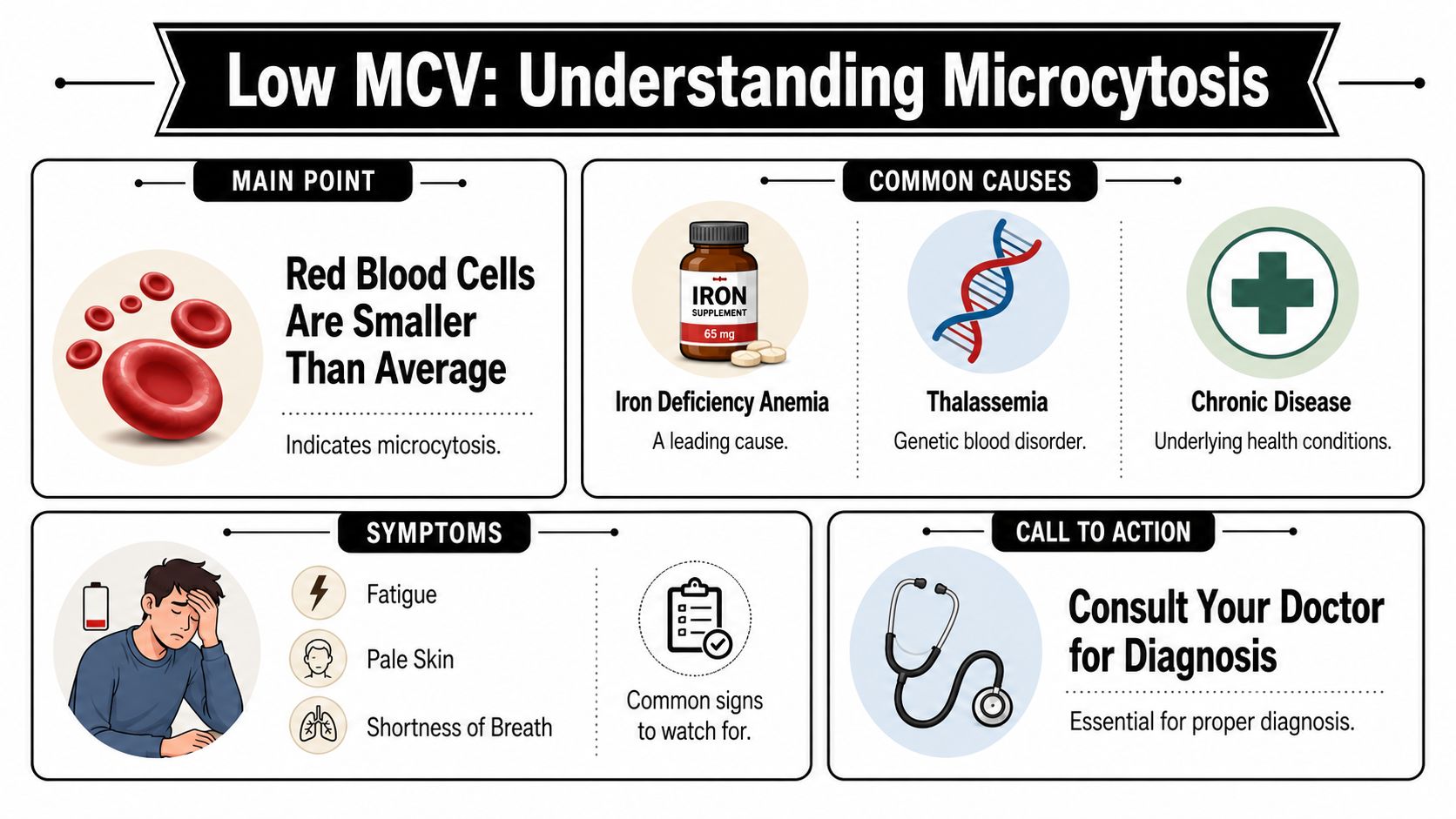
When MCV is low, the term is microcytosis. That means your red blood cells are, on average, smaller than expected.
Small red cells are commonly linked to iron deficiency, but that’s not the only possibility. In everyday practice, doctors often think through a short list of common explanations.
Common causes doctors consider
Iron deficiency. This is the classic cause people hear about first. Without enough iron, the body has trouble making enough hemoglobin to properly fill developing red blood cells, so the cells may end up smaller.
Chronic illness or inflammation. Some long-term medical problems can interfere with how the body handles iron and makes red blood cells. In that setting, the cells may also become small.
Thalassemia. This is an inherited blood condition that affects hemoglobin production. Some people with thalassemia trait feel well and only discover it because routine blood work shows a low MCV.
A patient example can help. If a young woman has fatigue, heavier periods, and a low MCV, iron deficiency moves higher on the list. If someone has a long history of small red blood cells and relatives with similar blood test patterns, thalassemia becomes more relevant.
Symptoms may come from the cause, not the MCV itself
Low MCV itself doesn’t create a feeling you can notice. What you may notice are symptoms tied to the underlying problem, such as:
- Fatigue
- Pale skin
- Shortness of breath
- Reduced exercise tolerance
- Feeling run-down or lightheaded
Those symptoms are nonspecific, which means they can happen for many reasons. That’s one reason your doctor won’t stop with MCV alone.
Questions your doctor may ask
To understand a low MCV result, I’d usually ask about:
- Bleeding history. Heavy periods, blood in the stool, frequent blood donation, or recent surgery.
- Diet. Whether you eat iron-rich foods and whether appetite has changed.
- Family background. A pattern of inherited blood traits can matter.
- Other health conditions. Inflammatory or chronic illnesses can change how the body uses iron.
A low MCV tells me to look for the reason your body is making smaller red blood cells. It doesn’t tell me the reason yet.
That distinction matters. People sometimes start iron on their own after seeing a low MCV. That can be the right treatment in some cases, but not in all cases. If the true cause is something else, self-treating can delay a proper diagnosis.
When Your Red Blood Cells Are Too Large High MCV
A high MCV result tends to raise different worries. Patients often ask whether it means a vitamin problem, liver problem, or something wrong with the bone marrow. Sometimes it can be one of those, but the main point is that high MCV gives your doctor a direction for the next step.

What high MCV points toward
Clinicians note that an MCV above 100 fL can point toward macrocytosis from B12 deficiency, folate deficiency, liver disease, bone marrow dysfunction, or chemotherapy exposure, according to this clinical overview of high MCV interpretation.
The term for large red blood cells is macrocytosis.
One common reason for macrocytosis is that the cells aren’t maturing normally before they leave the bone marrow. Vitamins such as B12 and folate play an important role in making new blood cells. When the process is disrupted, the cells may grow larger than expected.
Causes doctors often review
Here are some of the possibilities we think about in everyday practice:
Vitamin B12 deficiency
This can happen with low intake, poor absorption, or certain digestive conditions. Some people also have numbness, tingling, balance problems, or memory changes.Folate deficiency
Folate also helps with healthy red blood cell production. Low folate can create a similar blood pattern.Liver disease
Liver problems can affect red blood cell shape and size in ways that raise MCV.Medication effects or chemotherapy exposure
Some treatments affect the bone marrow or the way cells are produced.Bone marrow dysfunction
This is not the most common explanation, but it’s one doctors keep in mind, especially when several blood counts are abnormal at the same time.
Here’s a brief visual explanation if you want to see the concept described another way:
What a doctor listens for in the history
When someone’s MCV is high, I pay close attention to the story around the result.
I’ll ask about diet, stomach or intestinal symptoms, alcohol use, medications, cancer treatment history, and nerve symptoms such as tingling in the feet. Those details often matter as much as the number itself.
A mild increase can mean one thing. A clearly abnormal increase paired with fatigue, weakness, or other CBC changes can mean something else. That’s why a high MCV result should lead to thoughtful follow-up, not panic.
MCV Is Only One Piece of the Puzzle
This is the part many online explanations leave out. An abnormal MCV result alone cannot diagnose any health condition. Its real value comes from being interpreted with other tests, and even a normal MCV does not rule out anemia.
That’s exactly how doctors use it in real life. We don’t look at MCV in isolation. We read it next to the rest of the CBC and, when needed, order follow-up tests.

The supporting cast on your CBC
Three related tests often help make sense of an MCV result.
| Test | What it helps show | Why it matters |
|---|---|---|
| RDW | How much variation there is in red blood cell size | A mix of cell sizes can suggest the problem is evolving or mixed |
| MCHC | How concentrated hemoglobin is inside the cells | This adds color and density to the story of the red blood cell |
| Reticulocyte count | How many young red blood cells your bone marrow is making | This helps show whether your marrow is responding appropriately |
If you want a patient-friendly explanation of one of these related values, this guide on what MCHC means in a blood test can help.
How doctors combine the clues
Think of MCV as the opening sentence, not the whole chapter.
A doctor may reason through a pattern like this:
- Low MCV plus iron-related concerns in your history can make iron deficiency more likely.
- Low MCV with a family pattern may push inherited causes higher on the list.
- High MCV with signs of poor nutrition or absorption may point toward vitamin testing.
- High MCV with other abnormal blood counts may require a deeper look at marrow function.
- Normal MCV with low hemoglobin reminds us that anemia can still be present even when cell size looks average.
That last point surprises a lot of people. A normal MCV does not automatically mean everything is fine. Some kinds of anemia don't show up as small or large cells.
A single blood number rarely answers the whole question. Patterns answer questions.
A simple way to think about RDW
Patients often ask me about RDW because it shows up flagged right next to MCV.
I explain it this way. If MCV tells us the average size of the red blood cells, RDW tells us how mixed the sizes are. Imagine a parking lot full of cars. MCV tells you the average vehicle size. RDW tells you whether all the vehicles are similar, or whether there's a jumble of compact cars, sedans, and trucks.
That matters because mixed cell sizes can happen when the body is transitioning from one state to another, or when more than one issue is happening at once.
Why MCHC and reticulocytes help
MCHC adds another layer by showing how concentrated hemoglobin is inside the red blood cells. That can support or challenge what MCV seems to suggest.
Reticulocytes help answer a different question. Is the bone marrow making enough fresh cells? If someone is anemic, that's a key piece of the story. A marrow that's responding briskly creates a different pattern than a marrow that's underproducing.
The practical takeaway is simple. If your MCV is flagged, your doctor is usually reading it as part of a group. That's why follow-up questions and extra tests are not a sign that something was missed. They're part of reading the lab result correctly.
Your Next Steps After an Abnormal MCV Result
The most useful next step is to talk with the clinician who ordered the test. They know why the blood work was done, what symptoms you reported, what medications you take, and whether other parts of the CBC were also abnormal.
In many cases, the next step is not treatment right away. It's targeted follow-up testing.
What follow-up may look like
Your doctor may order tests such as:
- Iron studies if low MCV raises concern for iron deficiency
- Vitamin B12 and folate levels if high MCV suggests a vitamin-related cause
- A reticulocyte count to see how actively the bone marrow is making new blood cells
- A peripheral blood smear so a specialist can look directly at the blood cells under a microscope
- Other blood work based on your symptoms, history, and the rest of your CBC
What you can do right now
A few practical steps can make your follow-up visit more productive:
- Bring your full lab report. Don't rely on memory of a single flagged number.
- Write down symptoms. Fatigue, tingling, shortness of breath, heavy bleeding, weight change, stomach symptoms, or medication changes all matter.
- Don't start supplements blindly. Iron, folate, or B12 may help in the right situation, but it's best to confirm what problem you're treating.
- Ask whether repeat testing is needed. Trends over time often tell us more than one isolated result.
When patients understand why a doctor orders the next test, the process usually feels much less frightening.
If treatment is started, repeat blood work is often part of the plan. That helps your doctor see whether the red blood cell pattern is moving in the right direction.
Frequently Asked Questions About the MCV Test
Can diet really affect MCV
Yes, it can. Diet can influence red blood cell production, especially if you're not getting enough nutrients involved in making healthy blood cells. That said, diet is only one possible factor. Absorption problems, medications, bleeding, inherited conditions, and chronic illness can matter too.
If my MCV is only slightly high or low, should I worry
Usually, a borderline result is interpreted with caution, not alarm. Small shifts can happen, and what matters most is the context. Your symptoms, your hemoglobin, the rest of the CBC, and whether the pattern is changing over time all influence what your doctor thinks.
How long does it take for MCV to go back to normal
That depends on the cause and whether treatment is working. Red blood cells don't change overnight, so normalization usually takes time. Your clinician may repeat labs after treatment begins to check whether the pattern is improving.
Can a normal MCV still happen if I have anemia
Yes. This is a point many people miss. A normal MCV does not rule out anemia, because some forms of anemia show up with average-sized cells rather than obviously small or large ones.
Can illness or medications affect the result
They can. Medications, chronic medical conditions, vitamin problems, liver issues, and other health factors can all influence red blood cell size. That's why your medication list and medical history are important parts of interpreting the MCV blood test.
Should I be checking this number on my own regularly
It's fine to understand your labs, and I encourage that. But MCV makes the most sense when it's reviewed with the rest of the CBC and your clinical picture. If you want to stay informed between visits, focus less on one isolated number and more on the overall story your doctor is telling you about it.
If you're trying to make sense of blood test results and want reliable medical reading, you can explore the Free Medical Journals blog for more patient-friendly explanations and evidence-based health topics.