About this article
Medically reviewed- Written by
- Dr Paul Watson
- Medically reviewed by
- Dr Han Simpson
- Published
- July 29, 2026
- Medical review date
- September 8, 2026
- Evidence searched through
- September 8, 2026
- Next review due
- September 8, 2027
- Intended audience
- General Readers & Patients
- Geographic scope
- Worldwide
- Conflicts of interest
- None declared.
- Funding
- Website Owner
- Report a correction
- Report an error or editorial concern
- Medical disclaimer
- Read the medical disclaimer
You’ve probably had this moment at the sink or in the shower. A tender red lump appears on the skin, it hurts to touch, and you find yourself wondering if it’s just a spot, an infected hair follicle, or something you should get checked today. Looking at pictures of boils is a very normal first step, because the eye often wants reassurance before the body gets a chance to settle down.
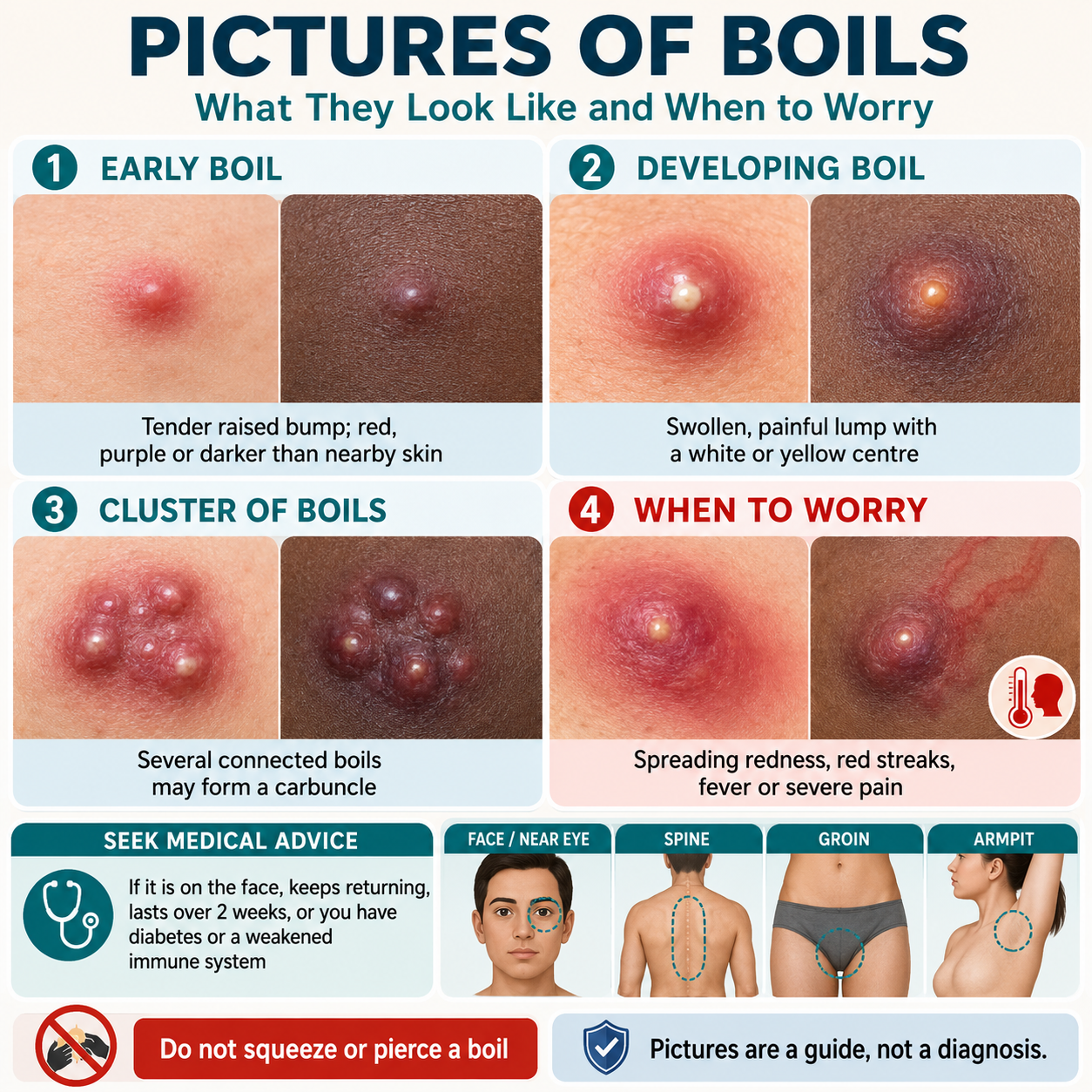 Pictures of boils showing what early, developing and clustered boils may look like, plus symptoms that may require medical advice.
A useful way to use image guides is as a quiet comparison tool, not a final diagnosis. Boils are common enough to show up regularly in primary care, but they’re still specific enough that not every sore red bump is one. In an overview from InformedHealth/NCBI, only about 3 out of 100 people who see a doctor for a skin infection have a boil, which is why careful visual comparison matters.
Practical rule: If a picture helps you ask better questions, it’s doing its job. If it makes you more uncertain, the next step is usually a clinician’s exam, not more scrolling.
The guide below walks through what boils look like, where people most often confuse them with other lumps, and what safe home care looks like while you wait and watch. It’s meant to leave you calmer, not more alarmed.

Why People Search for Pictures of Boils
A patient often lands here after a simple, uneasy discovery. A red lump on the arm, groin, neck, or thigh starts to ache, and the first question is usually, “Does this look like a boil?” That instinct makes sense. Skin problems are visual, and a clear image can help you decide whether you’re seeing a classic pattern or something that needs attention.
The reason pictures of boils are useful is that a boil has a recognizable story on the skin. It usually begins as redness and tenderness, then becomes a firmer bump, then forms pus, and finally drains or heals. That sequence helps separate a boil from a rash, a bite, or a simple irritated pore. A good medical photo is there to show that pattern, not to replace an actual exam.
What a good picture can and cannot tell you
A photo can show size, color, swelling, and whether there’s a central point. It can’t tell you how deep the infection is, whether there’s surrounding spread, or whether the lump is a cyst instead of a boil. That’s why image search is a starting point, not the finish line.
A calm way to think about it is this, a skin photo can tell you whether the lump looks boil-like, but only a person in the room can judge the rest. That matters because boils are real infections, not just annoying bumps. In a large UK primary-care cohort, researchers identified 164,461 people who consulted a general practitioner for a boil or abscess between 1995 and 2010, which shows how often these problems end up in ordinary family medicine care.
The same dataset found a higher first-consultation incidence in females than males, 512 versus 387 per 100,000 person-years. That doesn’t mean boils are a women-only problem, it means they show up in both sexes and are seen often enough that patients naturally look for visual confirmation. If you’ve opened image results with a worried stomach, you’re not overreacting. You’re trying to make sense of a skin change before deciding what to do next.
What a Boil Is

A boil, also called a furuncle, is a painful, pus-filled lump that forms when bacteria infect a hair follicle or oil gland. The skin around it becomes inflamed, the bump turns tender, and pus collects inside as the body sends white blood cells to fight the infection. In plain language, it is a blocked little opening on the skin that turns into a contained battlefield.
The usual culprit is Staphylococcus aureus, the most common cause identified by Mayo Clinic. This bacteria can live harmlessly on skin or in the nose for many people, so the problem is not always about catching something from outside. It often starts with a small break in the skin barrier, a rubbed follicle, or a tiny opening that gives the germ a chance to move in.
Boil versus carbuncle
A carbuncle is a cluster of connected boils. It is larger, deeper, and usually more uncomfortable than a single furuncle. I tell patients to picture several infected follicles linked together under the skin, rather than one isolated bump.
A boil is not just a “big pimple.” It is an infection in a follicle, and that difference is why it behaves the way it does.
Common places include the face, neck, armpits, and groin, areas where skin rubs, sweats, or has many hair follicles. Once you understand that pattern, the pictures make more sense. A boil usually is not flat, and it usually does not stay the same for long. It starts as a sore red lump, then becomes more defined and full of pus as the immune response builds inside it. That is why a close look at the skin, not just the fact that it hurts, helps make the diagnosis feel more concrete.
If you want a simple follow-up visual, the family of boil pictures often overlaps with staph infection stages. One helpful overview is the internal guide on staph infection stages pictures, which can make the timeline easier to recognize.
The Stages You See in Pictures of Boils

A boil rarely appears fully formed. It usually changes over days, not minutes. WebMD describes it as starting as a red lump, then filling with pus as white blood cells move in to fight the infection (WebMD). That slow change is exactly why the stage matters when you’re trying to match your own skin to a photo.
Early redness and tenderness
The first image many people find shows a small, sore, red bump. At this point, the skin may still look almost ordinary except for the tenderness. It can be easy to mistake this stage for an irritated pore or a pimple.
Firm swelling with a center
Next, the bump becomes more raised, tighter, and more painful. A pale center or a small white point may appear as pus gathers below the surface. This is the stage where people get most tempted to squeeze it.
Drainage and healing
As pressure builds, the boil may start to drain on its own. Once that happens, the pain often eases and the skin begins to settle, first with a scab and then with healing tissue. Most boils heal with home treatment or a doctor’s visit.
A patient once told me he tried to pop what looked like a “tiny whitehead” on day one. By the next day it was more swollen and much more painful, which is a common lesson with boils, they tend to follow their own timetable. The body usually does better when you let the process mature naturally.
Practical rule: If the bump is still just red and tender, it’s early. If there’s a visible white or yellow head, it’s moving toward drainage. If it has opened and started to settle, the healing stage has begun.
The main point is simple. A boil picture makes most sense when you place it on a timeline. A red bump, a firm swollen nodule, a pus-filled head, and then drainage. That sequence is the visual fingerprint people are usually looking for.
Common Conditions That Look Like Boils
Many people get tripped up. Many skin lumps look boil-like in photos, especially when they’re red, sore, or swollen. The surface clues can overlap so much that a picture alone sometimes can’t separate them. That’s why a doctor’s exam, and sometimes imaging, matters.
Side by side differences
Ultrasound is useful when the exam is unclear. A furuncle, or boil, is centered on a hair follicle and may show a small hypodermal abscess. A ruptured epidermal cyst tends to have lobulated, poorly defined margins and intermediate vascularity, while an unruptured cyst is usually oval, well circumscribed, and avascular. That sort of detail is hard to judge from a phone photo.
Here is a simple comparison for the most common look-alikes.
| Feature | Boil (Furuncle) | Epidermal Cyst | Inflamed Acne Nodule | Cellulitis |
|---|---|---|---|---|
| Usual feel | Painful, firm, localized lump | Round lump, may be tender if inflamed | Deep, sore nodule under the skin | Diffuse tender skin, not one clear lump |
| Center | Often develops a pus point | May have a punctum or none | Usually no true pus head at first | No central boil-like head |
| Location pattern | Hair-bearing areas, friction zones | Anywhere on skin | Face, back, chest, jawline | Larger skin area, spreads across tissue |
| Surface look | Red bump that can become pus-filled | May look smooth or swollen | Red, deep, acne-like bump | Redness without a single focal pocket |
| Imaging clue | Follicle-centered abscess | Well-circumscribed or ruptured cyst pattern | Often clinical diagnosis | Shows spreading inflammation, not one boil |
Inflamed acne nodules can feel deep and painful, but they usually fit an acne pattern rather than an infected follicle abscess. Cellulitis spreads more broadly across the skin, so the redness looks less like one “pimple with a head” and more like a patch of inflamed tissue. Hidradenitis suppurativa can also resemble boils, especially in the armpits or groin, but it tends to recur in the same areas and form multiple lumps.
A good mental checklist is this. If the lump is broad rather than round, if there’s no central point, if there are several lesions at once, or if the skin looks more like a spreading patch than a single abscess, pause before calling it a boil. Photos can point you in the right direction, but they can’t always close the case.
Safe Home Care Most Doctors Recommend

For a small boil that is not causing major trouble, warmth is usually the first home step to try. A clean cloth soaked in warm water and held against the boil for a short stretch can help the area soften and may encourage it to drain on its own.
The routine that keeps things simple
After the warm compress, cover the area with a dressing or gauze until it heals. Keep towels and bedding washed regularly at high temperature. These are plain steps, but they matter because a skin infection can spread through touch and shared fabric.
Do this instead of trying to hurry it along:
- Warm compresses: Hold the warm cloth gently against the boil, then let the skin rest before repeating.
- Clean coverage: Use a dressing or gauze if the area rubs on clothes or if it has started to drain.
- Laundry hygiene: Wash towels and bedding regularly at high temperature so bacteria do not linger on fabrics.
- Hand washing: Clean your hands well before and after touching the area.
Do not pick, squeeze, or pierce the boil. If you force it open, you can drive the infection deeper or spread it to nearby skin.
The NHS also advises avoiding swimming pools and gyms until the boil has gone, because you could spread the infection to other people. That advice is practical, not punitive. It protects other people and gives your own skin a quieter chance to settle.
I have seen patients improve by sticking to the compress routine instead of poking at the bump every few hours. Skin often does better when it is left alone and supported, not disturbed. If you can keep the routine steady, you are giving the body a better chance to calm the area down naturally.
Red Flags That Mean You Should See a Doctor
Mayo Clinic gives a short list of warning signs that are worth taking seriously: more than one boil at a time, rapid worsening, extreme pain, or recurrence. Those four clues are useful because they point to different kinds of trouble. Multiple boils can suggest ongoing bacterial carriage, fast worsening can mean the infection is spreading, severe pain can mean a deeper abscess, and recurrence can point to colonization or an underlying problem that keeps feeding the cycle.
How I’d think about the urgency
If it’s a single small boil and you feel otherwise well, home care is often reasonable for a short watch period. If the lump is getting bigger fast, is unusually painful, or you’re seeing several at once, that’s a GP review situation. If you have fever, feel ill, or the redness is spreading quickly, that moves you toward same-day medical assessment.
Advanced imaging is not needed for the usual boil, but it can help when deeper infection is suspected. MRI and CT patterns of abscess reflect the infection pocket, and the MRI penumbra sign has reported 54% sensitivity and 98% specificity for abscess PMC. That high specificity is reassuring when imaging is used, because it helps confirm a true abscess rather than guess at one.
Here’s the quick decision guide I’d give at the desk:
- Self-care today: one small boil, mild symptoms, no spreading redness, no fever.
- Book a GP visit: more pain than expected, not settling, recurring, or multiple lesions.
- Seek urgent care: rapid worsening, severe pain, feeling unwell, or infection on the face with concerning spread.
If you keep getting boils, the doctor may think about a culture, a search for colonization, or a broader review of what’s making your skin vulnerable. That’s especially true when the problem keeps coming back rather than resolving.
Putting It All Together
A boil usually starts as a red, tender bump, becomes a firm pus-filled lump, then drains and heals. The pictures help most when you place them on that timeline instead of treating any red spot as a boil. They also help you compare the usual look-alikes, especially cysts, acne nodules, and spreading skin infection.
The home routine is straightforward, warm compresses, clean dressing if needed, good hand hygiene, and no squeezing. One can safely watch a small boil for a short time if they feel well and it isn’t getting worse. The moment you see multiple boils, fast worsening, severe pain, or recurrence, the balance changes and a doctor should look at it.
If you remember only one thing, make it this. Pictures of boils are a guide, not a verdict. The skin image gives you clues, but a clinician’s eye makes the final call.
Common Questions Patients Ask Next
Yes, a boil can spread bacteria through pus or direct contact, so towels, washcloths, and close skin contact matter. The boil itself isn’t the whole issue, the infection inside it is.
Healing often takes time, and the skin usually settles over days to a couple of weeks if it drains and you leave it alone. If it keeps enlarging or doesn’t begin to improve, that’s a reason to be seen.
Popping a boil at home is not a safe shortcut. It can push infection deeper, spread it to nearby skin, and make the problem harder to settle.
A doctor may order a culture if the boil keeps coming back, seems unusually severe, or doesn’t behave like a routine case. A biopsy is not common for a simple boil, but it can come up when the diagnosis isn’t clear.
For more open-access reading on skin infections and related topics, visit Free Medical Journals and explore its journal directory and blog resources.